Cock of the rock
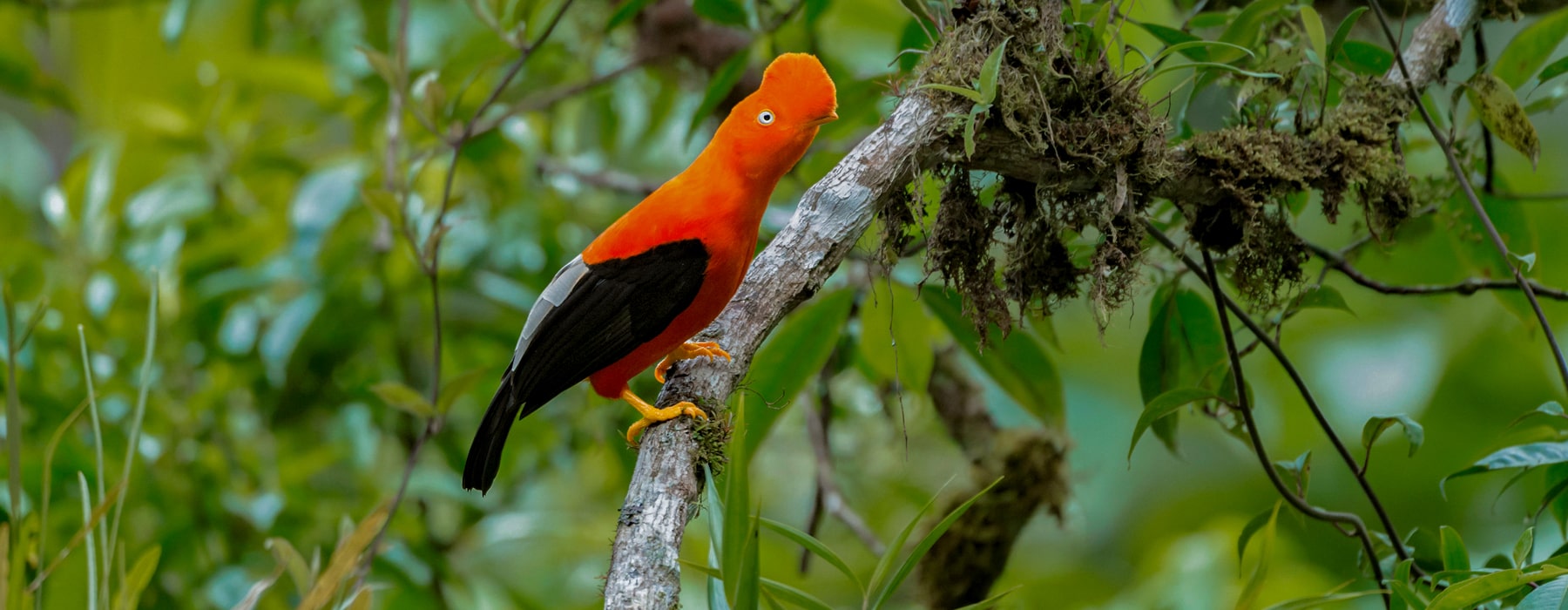
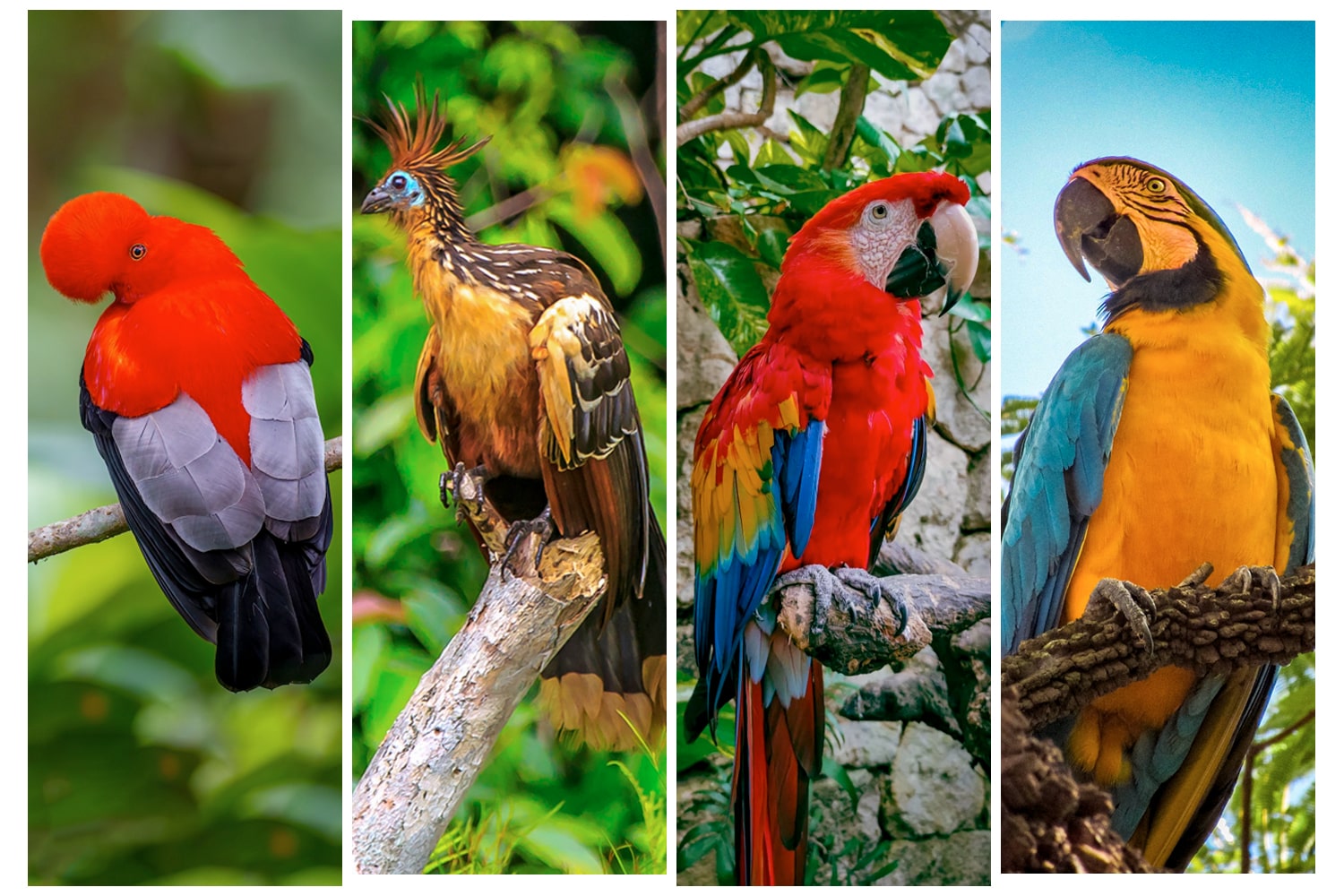
The cock-of-the-rock (Rupicola Peruviana), known in Quechua as "Punki" is the emblematic bird of Peru. It lives in the humid and cloudy forests of the eastern slope of the Andes, between 400 and 2500 meters above sea level. It is a beautiful species that in males has an orange crest that adorns its head. Black and white feathers cover the back and wings. As in most birds, the female's color is more subtle. During the mating season, they usually make ritual displays in groups along with characteristic hoarse sounds and cackling that arouse the interest of bird watchers. Due to its morphology, it is considered one of the most physically strange birds in the Amazon.
Hoatzin or shansho
The strange Hoatzin (Opisthocomus hozan) is not as pretty as toucans, tanagers or macaws, wins the prize for the strangest bird in the Amazon. Almost as large as a turkey, the Hoatzin spends its time resting around the lakes of the
Amazon rainforest. It settles on bushes and small trees that grow at the edge of the water and growl.
It has the dimensions of a pheasant, but is much more slender, with a longer neck and tail and a small head. The face is naked, with a bright blue color and a red iris; the head is adorned with an upright, scruffy, fan-shaped chalk. Its approximate size is 60 cm to 66 cm and it can weigh 816 g.
It has a limited ability to fly, since it does not need to travel long distances in search of food due to the type of diet it has. Unlike other birds, instead of insects or fruits, it eats only the hard leaves of trees like the renaco. The hoatzin decomposes its food through bacterial fermentation to transform it into liquid, which causes it to give off a strong odor that serves to scare away its predators. As the hoatzin is a gregarious species, it likes to make nests in small colonies.
A curious fact is that, for a long time, due to the two peculiar claws it has on each wing, which disappear when it reaches adulthood, scientists thought it was a descendant of Archeopteryx, a fossil bird considered the missing link of reptiles. that evolved into birds.
Scarlet macaw
It is the best known macaw (Ara Macao) in the world, due to the abundant scarlet red of its plumage. Also notable is the yellow color on the middle part of the wings and the blue on the rump and tail, which is long and pointed to give stability and direction to its flight. It has round, pale yellow to greenish eyes and are surrounded by white, featherless skin.
This macaw, which can measure between 84 cm and 92 cm and weigh between 900 g and 1500 g, likes to nest in tree holes, rock crevices or clay huts. Chooses a life partner when he turns 4 years old. The female usually lays up to four eggs, which are incubated for around 15 days. The young are born without feathers and are dependent on their parents for 25 days. The young are born without feathers and are dependent on their parents for 105 days, as they are fed by regurgitation. Only at one year are they completely independent, the age at which they leave the nest. Generally, the macaw feeds on seeds, fruits, insects and vegetables that it catches thanks to its powerful beak.
Like the blue and yellow macaw, the scarlet macaw is being registered as a vulnerable species due to the felling of trees in the Amazon, which reduces the availability of food and nesting places, and due to indiscriminate hunting, since it is in high demand. like a pet.
Blue and yellow macaw
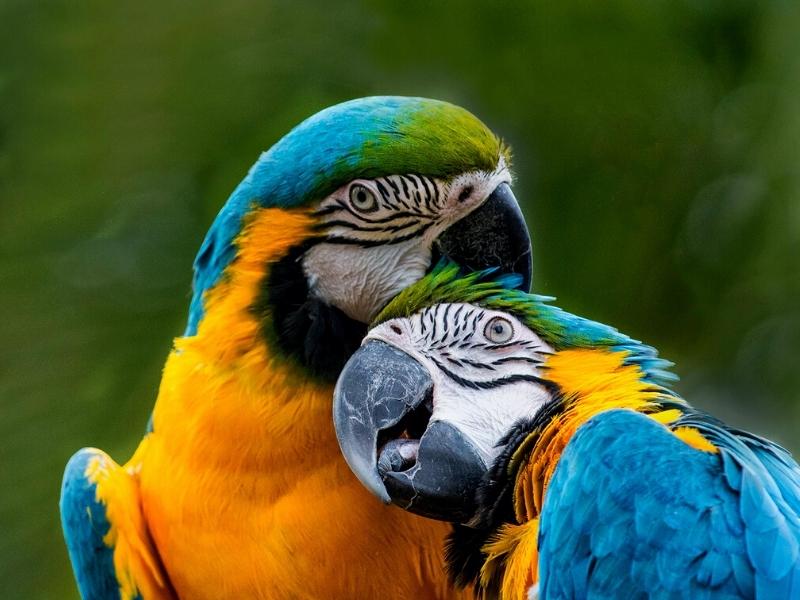
(Ara ararauna) This is one of the most colorful and spectacular parrots that the Amazon is home to. The combination of bright colors makes this bird an authentic work of art of nature. The wings are blue, part of the head too, but its chest and long tail are yellow. The size varies between 82 cm and 87 cm and the weight ranges between 900 g and 1300 g. It has a large, curved beak with which it feeds and helps it climb. The male is larger and has a stronger head and beak than the female. You can distinguish a young specimen from an adult by the color of the iris of its eyes. The first is yellow and the second is dark brown.
It feeds on seeds, plants and fruits, such as nuts and aguaje, but since some are toxic or poisonous, it eats clay from the river banks to counteract the harmful effect, and thus incorporates mineral salts into its diet. It nests in the hollows of palm trees and can travel up to 25 km in search of food.
It moves in pairs, in trios with its young, in small flocks and occasionally in large groups. It can be seen at sunrise or sunset. It is usually very boisterous when flying and very quiet when eating. It is a very long-lived animal, it can live over 50 years. But their numbers are decreasing, particularly due to hunting and the capture of their young to sell them as pets.