Now, among the drawings presented by
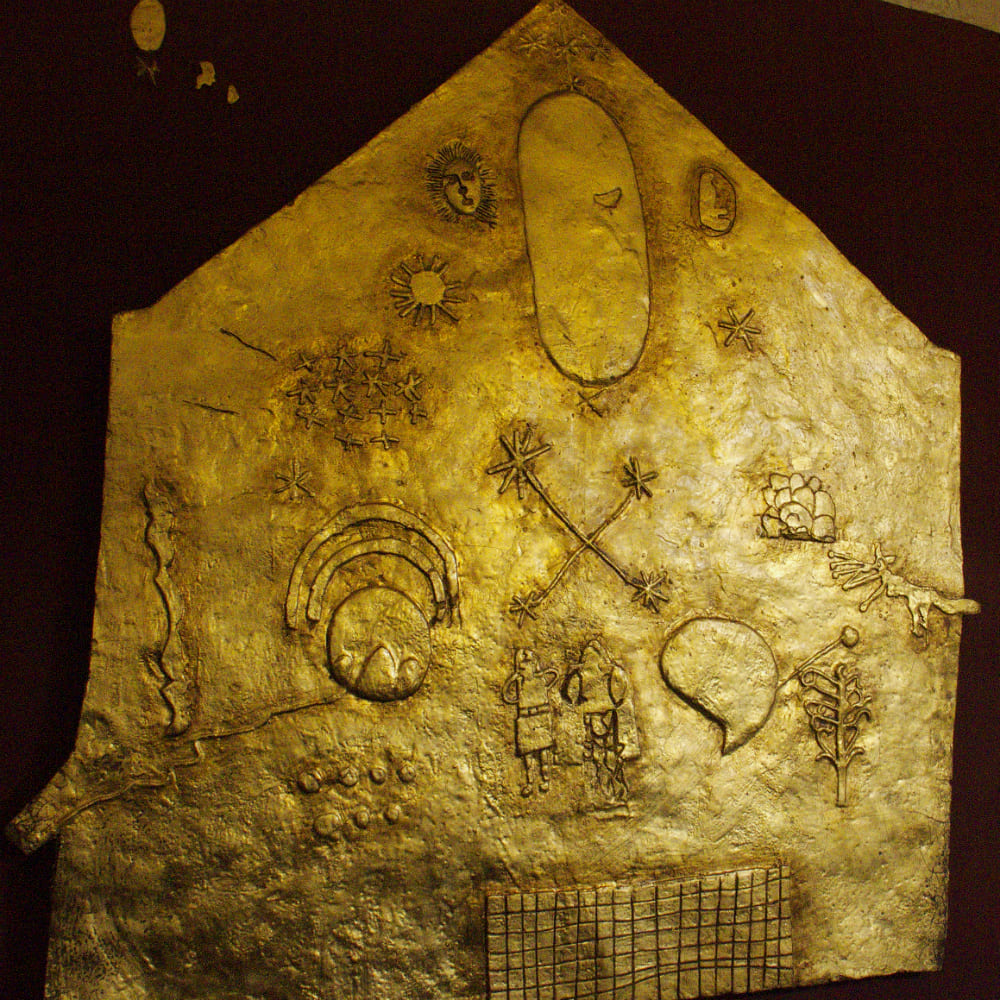
Pachacuti Yamqui's work is the main wall of the main altar of the Cuzco temple in Coricancha and which supposedly represents the Andean world view or the world map. He called such an engraving Chakana, which means a bridge or ladder and which allowed man to unite with the cosmos. It is actually a figure of four bridges joined together in the shape of a twelve-pointed square cross and with the image of a deity in the center. This symbol is millennial, it has been found in the Archaeological Complex of Ventarrón, Pomalca district, in Lambayeque, and it has the shape of a Chakana, boasting the surprising antiquity of between four to five thousand years, and would demonstrate the idea of cosmic separation between the World and the Computer, the immanent and the transcendent. It has been said that in its geometry the Chakana contains the concept of the unreal number Pi and the real number twenty-seven. In any case, it is not certain that such knowledge was characteristic of pre-Columbian knowledge, and what is important here is how Pachacuti Yamqui calls engraving. For him it is a bridge, a communicating link with another dimension. It is not surprising that an agrocentric civilization has to be cosmocentric within its desire to dominate nature. Consequently, it is not strange that Pachacuti Yamqui when describing the content of the Chakana includes stellar elements. But Andean cosmography is not the product of a primordial scientific interest, but of a sacral, oracular, theurgic and mantic scheme. In other words, the cosmographic is subsumed by the history of its religion and its desire for the numinous. There is no doubt that the chakana describes a limit situation of man, that is, revealing the sacred, cosmic and transhistorical, which indefinitely repeats the celestial archetypes. In other words, the chakana is the record of what the shaman or amauta manage to see or know in the mystical trance or speculative meditation. But what the author is going to offer us is the first syncretic image of Andean religiosity, since it mixes Andean elements with Christian elements. The result is a hybrid, a recomposition of the new image of the world that Andean men have after the Conquest.
Indeed, the world is organized according to the Andean principle of Hanan-Hurin applied in two dimensions, the horizontal and the vertical. Two axes, Hanan and Hurin, divide the space into four different fields. The lower fields are arranged inversely with respect to the upper space. Such quadripartite structures are found in other Andean spatio-temporal representations. The Order is headed by the deity of Viracocha Pachayachachic or Lord of the Universe, computer of everything that exists, in which the human couple is a harmonious part of the whole. It is curious that his name is mentioned on an ovoid figure, which could allude to the cosmic egg as the axis of the world and of all the celestial regions. The representations of the Sun and the Moon, as well as other stars, are not astronomical figurations but religious characters. The frame and contour of Pachacuti's drawing, as well as the distribution of his figures, resembles the altarpiece of a Christian church, which leads us to think that he prefigured it so that it can be accepted by a Spanish audience.
It would be, then, the Altarpiece of Ordination and not of Creation, where the Universal Lord orders everything to the right and to the left, in pairs. It is striking that the Ucu Pacha or the world below is not consigned, especially since the Incas considered that a way of life similar to that experienced in this world continued after death. This omission leads us to suppose that such a world may be concealed in the drawing of the mamapacha or the mamacocha, as means of access to the Ucu Pacha. Tradition tells that Manco Cápac had fixed the image of Wiracocha Pachayachachic on a wall of the Coricancha, and that Mayta Cápac had that plate renewed by adding various figures around it. According to Santacruz Pachacuti, the Coricancha painting should teach us to remember the exclusive power of Wiracocha in opposition to the very inferior powers of all things in the world, who were but his creatures and who, therefore, must refrain from worshiping any of its creatures, although it was the highest, that is, that the Peruvians had to despise the polytheistic cults (for example, the cult of the sun).
If the Inca Garcilaso wanted to save the social organization of the Inca, especially the principle of justice, and the Andean people of the sixteenth century organized magical ceremonies in the huacas of the Taqui Oncoy to expel the invader, Santacruz Pachacuti wanted to save their religion by expunging the polytheism. The difference with Guamán Poma is that he attributes the introduction of solar idolatry to the Incas themselves and frees from that defect the pre-Inca Indians who, according to him, worshiped a single god. Our Indian chronicler, Santacruz Pachacuti, apparently intended to prove by interpreting the cosmogonic altarpiece that the Incas were not idolaters, worshiped a single god, and disliked polytheism. If this is the case in practice, he would have no chance of success, because his work is written in the midst of the campaign to extirpate idolatries, the memory of the Toledo chroniclers who attributed idolatrous character to the Inca religion remained, and, furthermore, It was known that a pantheon of tectonic gods or sustenance divinities such as water or Illapa, and earth or Pachamama existed alongside the Uranian god Wiracocha. At the time of the Conquest, the divinity that received the most attention was Illapa, and eighty years later, that is, when Santacruz wrote its chronicle, the resistance of Andean religiosity was concentrated in Wiracocha. Such a strategy did not work, in time said divinity would be forgotten and its place would be occupied by the Christian divinity.
In other words, Santacruz tries to make a Christian reading of the Andean cosmogonic altarpiece, with a single universal and creative god, who rejects all polytheism and who does not have the object of persecuting the cult of Wiracocha because basically it is the same Christian god. But it is very plausible that in the drawing our Indian chronicler has purposely omitted other original Andean representations, such as the Ucu Pacha or Hell, and forced the religious representation of
the Inca to make it compatible with the Christian one. But the ethnological and historical confirmation leads us, rather, towards a henotheistic religion, with a main god and several secondary divinities. Santacruz must have accepted Christianity acceptably, because in his drawing of the altarpiece there are no traces of the theogonic myth of the original chaos that must accompany an ordering divinity.
In short, Santacruz Pachacuti defines Viracocha as creator god, omnipotent and unique in front of his creatures, as if it were the proper understanding of those Gentiles, because this statement had the scope to defend their own with the argument that the Incas reached such understanding by the natural light of reason. Consequently, they only lacked the light of revelation. What follows from this argument he did not say but it follows, that is, once Christian revelation has been reached, they will be capable of self-government.