



 trip overview
included
Trip Highlights
activities
accommodations
itinerary
packing list
faq
essential trip information
best season to travel
price & availability
Reserve Online
trip overview
included
Trip Highlights
activities
accommodations
itinerary
packing list
faq
essential trip information
best season to travel
price & availability
Reserve Online
 CREATING AUTHENTIC TOURS IN PERU
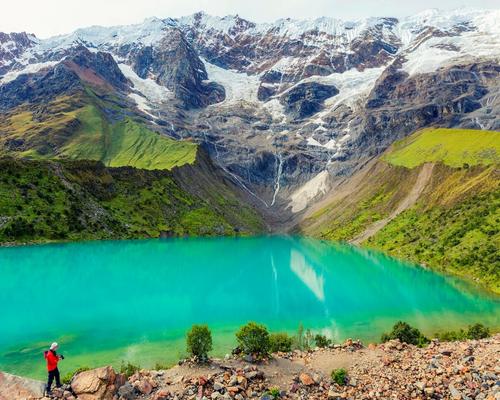
Nestled in the heart of the Peruvian Andes, the vibrant city of Huaraz serves as the gateway to the Cordillera Blanca, the world’s highest tropical mountain range. This is the starting point of the legendary Santa Cruz Trek, an experience that immerses you in a landscape of such spectacular beauty that it is often called the “Switzerland of Peru.” Leaving the city behind, the journey takes you through the breathtaking Llanganuco Valley, where the turquoise waters of Lakes Orcococha and Chinacocha stand like precious gems in the shadow of towering glacial peaks such as Huascarán and Huandoy. The trek itself is a prelude, offering a first glimpse of the magnitude and majesty that awaits you upon crossing the Portachuelo de Llanganuco pass, a viewpoint that offers a stunning panorama of the pristine wilderness you are about to enter on foot.
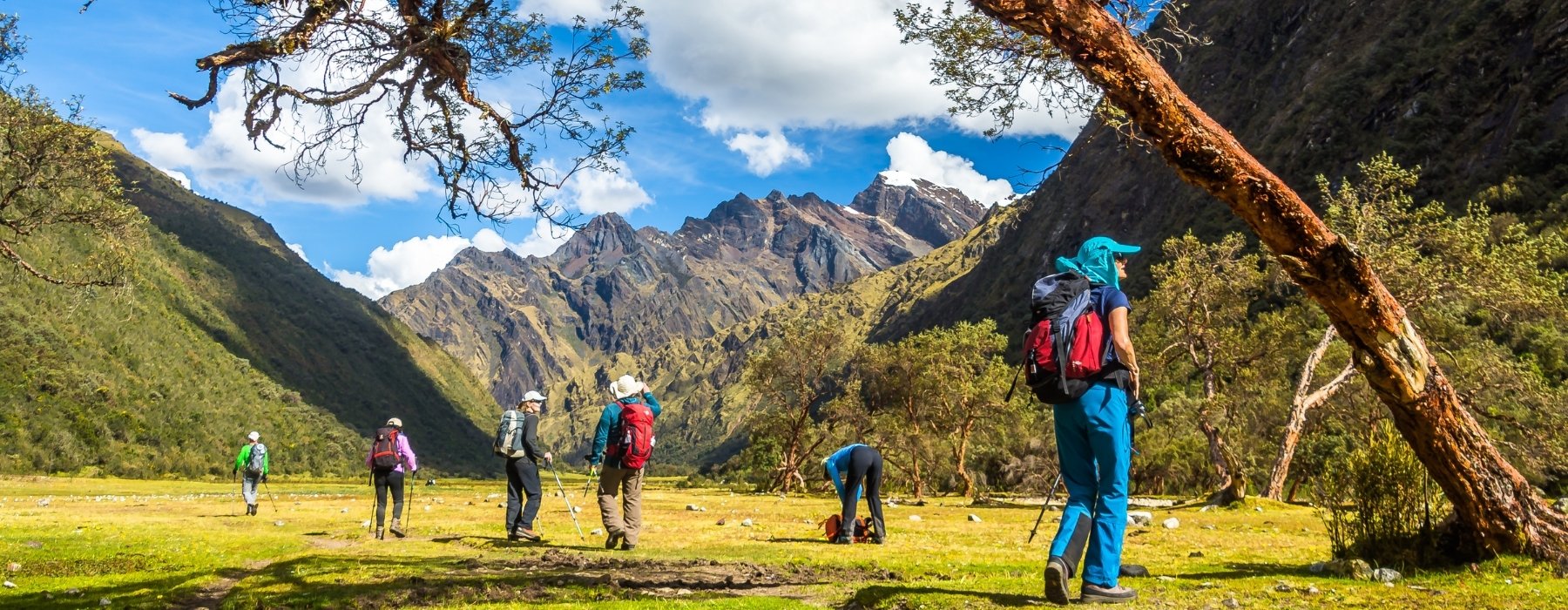
Over the next few days, the Santa Cruz Trek unfolds like a living postcard, taking you through the remote and rugged valleys of Huaripampa and Santa Cruz. The trail winds alongside crystal-clear glacial streams and through ancient forests of queñua, a gnarled, high-altitude native tree that adds a touch of mystical verdure to the rocky terrain. At every turn, the Cordillera Blanca reveals its iconic sentinels: the majestic Taulliraju, the pyramid-shaped Artesonraju, and the revered Alpamayo, often considered the “most beautiful mountain in the world” for its breathtaking, symmetrical ice-capped peak. The silence of the Andes is broken only by the distant roar of an avalanche or the soft tinkling of bells from a herd of llamas, creating an atmosphere of profound peace and remoteness.
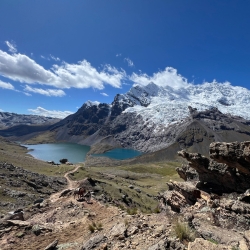
The highlight of this breathtaking journey is the ascent to Punta Unión Pass, the highest point of the trek at 4,750 meters (15,584 feet). The climb is a rewarding challenge, and the summit rewards you with one of the most spectacular 360-degree views in South America. From this natural balcony of the Santa Cruz Trek, you’ll gaze upon a sea of craggy, snow-capped peaks like Quitaraju, Rinrijirca, and Pucajirca, all towering majestically above deep valleys that cradle sapphire and emerald glacial lakes. The air is thin and crisp, and the panorama is so vast and stark that you feel as if you’re on the roof of the world, gazing down upon a pristine, frozen ocean of stone and ice.
The Classic Santa Cruz Trek is one of the most popular trekking routes in the Cordillera Blanca. The trail traverses fertile alpine valleys, offering views of magnificent spiraling glacial peaks, flowering meadows, and turquoise glacial lakes. This world-renowned circuit crosses the Cordillera Blanca from one side to the other, ascending the Punta Unión Pass, which reaches an altitude of 4,750 meters, and then descending into the lush Paria Valley. As we hike through the Paria Valley towards Vaquería, the end of the route, we will pass through the small mountain village of Huaripampa, where we will have the opportunity to meet the warm, friendly, and welcoming Quechua mountain people.
Arriving in Huaraz means stepping into the heart of the high Andes, where the city sits at 3,052 meters (10,013 feet) above sea level. Before embarking on demanding treks like the Santa Cruz Trek, which reaches heights of over 4,750 meters, proper acclimatization is essential to prevent altitude sickness and ensure a safe, enjoyable experience. We strongly recommend arriving in Huaraz at least two full days before your trek begins. During this time, you can explore nearby sites such as the tranquil Lake Wilcacocha or the impressive Churup Lagoon—both excellent “warm-up” hikes that help your body adjust to the thin mountain air while offering stunning views of the Cordillera Blanca. Remember to stay hydrated, avoid heavy meals and alcohol, and listen to your body. A well-acclimatized traveler is a happy trekker, ready to fully embrace the majesty of the Andes.
Each evening on the Santa Cruz Trek, you’ll settle into a series of carefully chosen campsites nestled deep within the Cordillera Blanca, each offering its own unique Andean character. The first night is typically spent at the scenic Llanganuco campsite, surrounded by towering peaks and the gentle rush of glacial meltwater. The second night brings you to the peaceful Taullipampa campsite, sitting directly beneath the impressive granite spires of the Taulliraju mountain, where the stars emerge with breathtaking clarity in the ink-black sky. The final night is often at the tranquil Huaripampa Valley campsite, a lush, green oasis nestled between dramatic mountain walls. These basic but well-situated campsites provide more than just a place to rest your head—they offer front-row seats to some of the most spectacular sunsets and sunrises in the Andes, with the sounds of distant avalanches and flowing rivers serving as your nightly lullaby.
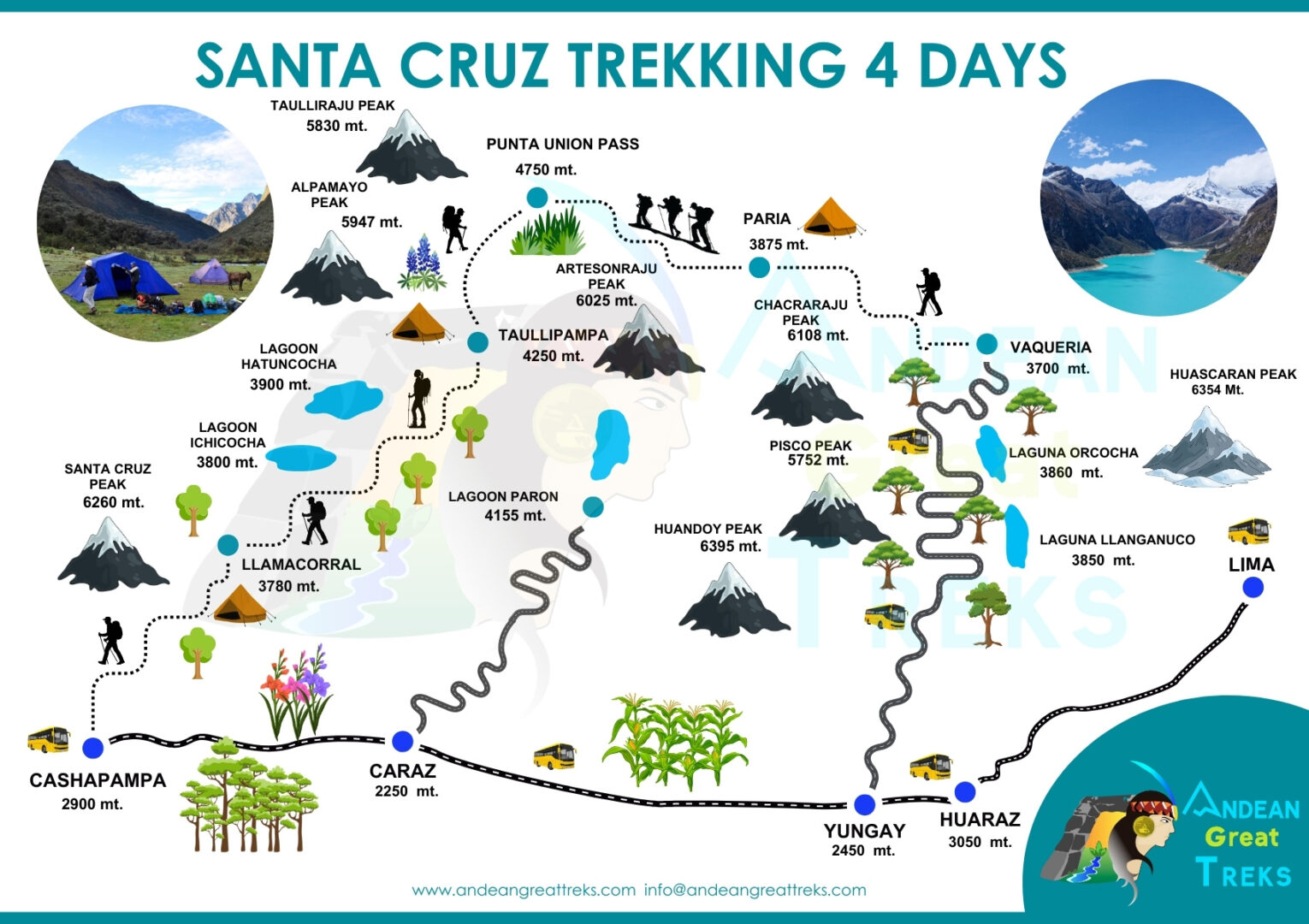
We begin the tour in the city of Huaraz, located at 3100 meters above sea level. Early in the morning, at 8:00 AM, transportation will pick you up from your hotel. We will stop for breakfast along the way. During the journey, you will be able to admire the incredible Callejón de Huaylas (Huaylas Valley). We will then enter Huascarán National Park, where we will stop to register. Continuing our journey, we will arrive at the Chinacocha and Orconcocha lagoons. At kilometer 42, we will stop to admire the southern face of Huascarán Mountain. Next, we will stop to observe the turquoise Llanganuco Lagoon (4785 meters above sea level). From here, we will be able to see the highest peaks of the Cordillera Blanca, such as Huascarán, Huandoy Peak, Pisco, Chacraraju, and Chopicalqui. Finally, we will descend to Vaquería, at 3700 m (12,139 ft). This is where our hike begins. We descend to a trail that branches off to the left, over a small ridge, towards the remote Huaripampa Valley, nestled among mountains. As we slowly ascend through this valley, we will pass a small settlement of farmers going about their agricultural activities. Walking through areas of lush Andean flora, we will soon catch sight of the snow-capped Chacraraju. We will also soon see Taulliraju as we walk alongside meadows and grazing fields. We will camp in the Paria Valley at 3875 m (12,713 ft).
The second day is the toughest; it’s the day we climb to Punta Unión, the highest point of the trek, at 4,750 meters. We wake up at 6:00 am with a cup of coca tea, have breakfast at 6:30 am, and usually start hiking around 7:00 am. The climb to Punta Unión is gradual, with some flat sections. The final part becomes steeper and more demanding due to the altitude. During the ascent, we’ll make several stops to rest and catch our breath, and of course, to take photos. We’ll reach the Punta Unión pass (4,750 m) around 1:00 pm, after about five and a half hours of climbing. From this point, we’ll see Mount Taulliraju towering above us and, on the other side, a crystal-clear glacial lagoon and a brilliant white glacier that add color and contrast to the breathtaking views of the Santa Cruz Valley. We will also have views of the Quitaraju, Artesonaju, and Rinrijirca peaks, as well as the Ichiccocha and Jatuncocha lagoons. After lunch and a group photo, we begin the descent (1 hour and 45 minutes) to our second campsite at Taullipampa (4,250 m). At the campsite, you will enjoy hot drinks and snacks. We will spend the night in the tent, enjoying the star-filled sky.
After breakfast, the hike begins at 7:20 a.m. The trail gently ascends to the Alpamayo Viewpoint, a natural balcony offering one of the most iconic and breathtaking views in the region. Here, hikers are rewarded with a privileged perspective of the perfectly pyramided Alpamayo mountain, often considered one of the most beautiful mountains in the world, along with the peaks of Quitaraju and Santa Cruz. The hike to the lake is divided into three sections: two uphill stretches with a flat section in between. After enjoying the majestic scenery, we begin the descent to Laguna Arhuaycocha, a glacial jewel of milky turquoise blue, located at the foot of the snow-capped giant. Its waters receive ice calving in a spectacular natural display. The path is lined with purple lupin blossoms, making it a true paradise in the Peruvian Andes. At 1 p.m. we met for lunch and then began the descent, which transforms the landscape, leaving behind the rocky, glacial terrain to enter the heart of the valley. The trail follows the course of the Arhuay River, winding through a mosaic of queñua trees and extensive puna grasslands. This final stretch offers a fascinating contrast, with views of the canyon walls and the possibility of observing local wildlife, such as tarucas (Andean deer) or vicuñas. The hike concludes at the Llamacorral area. In the afternoon, we spent the night near the river that flows down from the snow-capped peaks, with spectacular views of the glaciers.
The return trail begins a gradual descent through the Santa Cruz Ravine, following the river’s course. You’ll be able to calmly enjoy the final landscapes of Huascarán National Park. The dusty path descends gently, offering different perspectives of the canyon walls and, with luck, the chance to spot Andean birds before reaching the village of Cashapampa (2,900 m), the official end point of the trek. In Cashapampa, a vehicle from the agency will be waiting to begin the return trip. The journey by car takes approximately 3 hours. The route winds from Cashapampa towards the town of Caraz, then continues through the Callejón de Huaylas, skirting the imposing Cordillera Blanca. Finally, you’ll arrive in the city of Huaraz (3,100 m), concluding this unforgettable high-altitude adventure.
 warm jackets
 Hydration bladder
 wool socks
 camera
 scarf
scarf
 first aid kit
 hiking shoes
 Dry bags
 Trekking Poles
 sun cream
 Snack
Snack
 sun hat
 bathing suite
 rain coat
 Sandals
 insect repellent
 Passport
 Down Jackets
 toilet paper
 daypack
 Wool cap
 head lamp
 gloves
 sun glasses
 cap
cap
 extra cash
 Trekking pants
The Santa Cruz Trek is the most iconic and popular mountain hike in the Cordillera Blanca in Peru, considered by many to be one of the most beautiful treks in the world. It is located in the Ancash region, within Huascarán National Park, a UNESCO World Heritage Site since 1985. This route traverses a breathtaking landscape that combines imposing snow-capped peaks exceeding 6,000 meters, intensely turquoise lagoons, glacial valleys carved by ancient glaciers, and unique Andean biodiversity that includes viscachas, condors, and a diverse array of high-altitude flora.
The trek connects two spectacular valleys: the Llanganuco Valley to the east and the Santa Cruz Valley to the west, offering hikers an immersive experience in the majesty of the Peruvian Andes. Throughout the journey, you can appreciate some of the most iconic mountains of the mountain range such as the imposing Alpamayo (once considered the most beautiful mountain in the world), Huascarán (the highest peak in Peru), Artesonraju, Pirámide, Taulliraju and Quitaraju, among others, making each day an unforgettable visual spectacle.
The total distance of the Santa Cruz Trek varies approximately between 45 and 52 kilometers, depending on the specific route taken and whether optional detours to additional viewpoints are included. The classic and most recommended duration to fully enjoy the experience is 4 days and 3 nights, allowing for a leisurely and safe walking pace, with enough time to appreciate the scenery, take photographs, and properly acclimatize to the altitude. This 4-day version distributes the effort evenly, with daily hikes of between 5 and 7 hours of actual walking.
However, there is also the option of completing the trek in 3 days and 2 nights for hikers in better physical condition and with more experience in high-altitude mountaineering, although this involves longer and more demanding days that can exceed 8 hours of hiking. Some extremely fit travelers even complete it in 2 days, but this option is not recommended for most visitors, as the physical exertion and lack of proper acclimatization can significantly increase the risk of altitude sickness and diminish the enjoyment of the scenery.
The Santa Cruz Trek is generally classified as moderately difficult, meaning it doesn’t require technical climbing skills or prior mountaineering experience, but it does demand a reasonable level of fitness and good preparation. The route follows well-defined and marked trails, without needing to cross technically challenging terrain such as glaciers or climbing areas, making it accessible to people with determination and basic training. The main difficulty lies not in the technical complexity, but in the physical endurance required to hike for several hours a day at high altitude.
The true challenge of the trek is cumulative: combining long days of hiking with a light pack (if you hire a muleteer), sleeping in cold camps, and the constant effort of breathing in a low-oxygen environment. For someone with a sedentary lifestyle, the trek can be very demanding, while someone accustomed to regular exercise and with prior mountain hiking experience will find it challenging but entirely achievable. The most important thing is to maintain a constant and slow pace, especially on the climbs, always listening to the body’s signals.
During the four days of the trek, hikers remain consistently above 3,500 meters above sea level, moving within an altitudinal range that varies approximately from 3,600 meters at the lowest points of the valley to 4,750 meters at the summit. This prolonged stay at high altitudes is precisely what makes proper acclimatization necessary, as the body works in hypoxic (low oxygen) conditions throughout the trek, which affects cardiovascular endurance and muscle recovery.
The highest point of the entire route is the famous Punta Unión pass, located at 4,750 meters (some sources place it at 4,760 m), and represents the peak of the hike in terms of both effort and visual reward. Reaching this pass on the morning of the second or third day (depending on the chosen route) is a moving experience, as it offers spectacular panoramic views of the surrounding snow-capped peaks. The ascent to Punta Unión is the most physically demanding part of the trek, with a considerable elevation gain that tests the hikers’ endurance and acclimatization.
The Santa Cruz Trek has a marked seasonality due to the climatic conditions of the Peruvian Andes, and the best time to do it is during the dry season, which runs from May to September. During these months, the days are mostly sunny and clear, the nights are cold but dry, and the probability of rain is minimal, guaranteeing trails in good condition and unobstructed views of the snow-capped peaks. It is precisely during these months that the influx of national and international tourists reaches its peak, so it is recommended to book the services of guides and muleteers in advance.
The months of April and October are considered transitional, with more variable weather that can alternate between sunny days and sudden rain showers, making the trek still possible but with some weather uncertainty. In contrast, the rainy season, which runs from November to March, presents significantly greater challenges: trails become muddy and slippery, rivers can swell, making crossings difficult, the risk of landslides and mudslides increases, and low clouds often obscure the most spectacular scenery. Trekking during these months requires more preparation, good-quality waterproof gear, and flexibility in your plans.
The most popular option for travelers to get from Lima to Huaraz is the interprovincial bus, which offers excellent value for money and allows you to enjoy the changing scenery along the way. Well-known companies like Cruz del Sur, Movil Bus, and Línea offer overnight services departing around 9:00 p.m. and arriving in Huaraz between 5:30 a.m. and 7:00 a.m. the following day, thus optimizing travel time. The journey takes approximately 8 hours and follows the Central Highway to La Oroya, then continues along the route that crosses the beautiful Pativilca Canyon, offering spectacular views at sunrise.
Air travel is an option, but it is limited and unreliable for planning with certainty. LATAM Airlines operates occasional flights from Lima to Comandante FAP Germán Arias Graziani Airport, located in Anta, just 25 minutes from Huaraz. However, this option is usually considerably more expensive than the bus, flights are not daily, and they can be canceled at short notice due to weather or technical reasons. For these reasons, most experienced travelers and backpackers opt for the overnight bus, which also allows them to save on a night’s accommodation in Lima.
Since 2026, all visits to the Santa Cruz Trek must be made through a travel agency authorized by the Peruvian Ministry of Tourism and the Ministry of the Environment. Hiring a travel agency offers significant advantages, especially for those without high-altitude mountaineering experience or who simply prefer a more comfortable experience. A tour includes a professional trekking guide (familiar with the route, its risks, and the best campsites), a cook who prepares hot and nutritious meals, and muleteers with their donkeys who carry most of the equipment. This allows you to hike with a light backpack of only 5-7 kg, enjoying the scenery more and reducing the risk of injury or exhaustion.
If you book an organized tour with a travel agency, prices range from US$600 to US$1,000 per person, depending on the agency’s reputation, the group size, the quality of the equipment, and the guide’s experience. More affordable agencies typically offer basic services with large groups, while more expensive ones guarantee certified guides, better meals, higher-quality tents, and more personalized attention. A reasonable price for a quality tour is around US$800, which includes a guide, cook, muleteers, all meals during the trek, camping equipment, and round-trip transportation from Huaraz.
A standard 4-day Santa Cruz Trek tour typically includes a range of services that greatly enhance the experience. First, it includes round-trip transportation from Huaraz to the trek’s starting and ending points, usually in private or shared vehicles arranged by the agency. It also includes the services of a professional trekking guide who speaks English and Spanish, a cook specializing in mountain cuisine, and muleteers with their donkeys who transport the group equipment (tents, cooking gear, food) and a personal bag of up to 8-10 kg per trekker.
Regarding equipment, the tour provides camping tents (generally for two people), a dining tent with a table and folding chairs for protection from wind and rain during meals, sleeping mats, and all necessary cooking equipment. Meals are fully provided during the trekking days, including nutritious breakfasts, hot lunches, complete dinners, and snacks such as fruit, cookies, and hot drinks (tea, coffee, hot chocolate). Many agencies also include a first-aid kit and, in some cases, an emergency horse in case a hiker is unable to continue due to health problems or exhaustion.
Sleeping bags and trekking poles are not usually included, although most agencies offer them for rent for an additional $25, depending on the quality of the equipment. Another important aspect is tipping for the local staff, a common and highly valued practice in Peruvian trekking culture. It is recommended to allocate between 50 and 100 soles in total to be divided among the guide, the cook, and the muleteers, depending on the quality of service received and the duration of the trek. Additionally, accommodation in Huaraz before and after the trek is the responsibility of the traveler, as are meals in the city and travel insurance, which, although not mandatory, is highly recommended to cover possible medical emergencies or evacuations.
To do the Santa Cruz Trek, it is essential to bring your original identity document, either your DNI (National Identity Document) for Peruvians or your passport for foreigners, as it will be requested at the entrance checkpoint to Huascarán National Park. It is advisable to also bring some photocopies of your passport just in case, although the original is the valid document for registration. Foreign citizens must ensure that their passport is valid for at least six months from the date of entry into Peru, although this is more relevant for general immigration control than specifically for the trek.
In addition to personal documents, you need your Huascarán National Park entrance ticket, which can be purchased at the access control points. This ticket is personal and non-transferable and must be kept with you throughout the trek due to possible random checks. No additional special permits or mandatory vaccinations are required to enter the park, although it is always recommended to be up-to-date with your basic vaccination schedule (tetanus, hepatitis) before any trip to remote areas.
Altitude sickness, known locally as soroche, is the physiological response of the human body to exposure to high altitudes where the partial pressure of oxygen is lower. Basically, when ascending above 2,500 meters, the air contains less oxygen by volume, forcing the body to work harder to oxygenate the blood and tissues. This situation causes a series of symptoms that can vary in intensity depending on individual susceptibility, the rate of ascent, and the degree of prior acclimatization.
The most common symptoms of altitude sickness include persistent headache, nausea or vomiting, dizziness and vertigo, unusual fatigue and general weakness, loss of appetite, difficulty falling asleep or restless sleep, and in more severe cases, shortness of breath even at rest. It is important to understand that these symptoms are not a matter of being in good or bad physical shape, but rather of how each individual body reacts to hypoxia. That’s why some very athletic people can suffer severely from altitude sickness, while others with less training tolerate it perfectly.
Altitude sickness prevention begins long before the trek starts, with proper gradual acclimatization in Huaraz and its surroundings. The universal recommendation is to spend at least two or three nights in the city (3,052 m) before undertaking any high-altitude hike, and during those days take acclimatization excursions to lagoons such as Wilcacocha (3,700 m), Churup (4,450 m), or the famous Laguna 69 (4,600 m). These shorter hikes allow the body to begin producing more red blood cells and gradually adapt to the lower oxygen availability, preparing it for the greater exertion of the trek.
During the trek, preventative measures are equally important: maintain a slow and steady pace, especially on ascents (the famous “platform pace” or slow but steady walk), stay hydrated by drinking small sips of water every 20-30 minutes, avoid heavy and fatty meals that hinder digestion, and refrain from consuming alcohol or tobacco. Coca leaf tea, an ancient Andean tradition, is very effective in relieving mild symptoms and is available at all campsites and restaurants. In case of moderate or severe symptoms, the only truly effective treatment is immediate descent to a lower altitude.
Although not mandatory for entering Huascarán National Park, travel insurance with coverage for high-altitude activities is highly recommended and could be considered almost essential for a worry-free Santa Cruz Trek. Good insurance should cover not only medical expenses for common illnesses or accidents, but specifically helicopter or ground vehicle evacuation from remote mountain areas, as well as rescue in case of emergency. These services, if needed without insurance, can cost tens of thousands of dollars, and their logistical organization is complex in the Andean terrain.
In addition to evacuation, it is important that the policy includes coverage for trip cancellation due to health reasons, lost luggage, and civil liability. Many international insurers specializing in adventure travel, such as World Nomads and SafetyWing, as well as local companies, offer specific plans for trekking in Peru that meet these requirements. When purchasing insurance, be sure to verify that the fine print explicitly includes coverage for activities up to 5,000 meters above sea level, which is the altitude range where the Santa Cruz Trek takes place.
In case of a minor injury such as sprains, blisters, or mild general malaise, the trekking guide is trained to provide basic first aid and make decisions about whether or not to continue the trek. Professional guides carry first-aid kits with essential medications, bandages, pain relievers, and wound care supplies. In cases of altitude sickness that do not improve with rest, the primary strategy is to descend to a lower altitude. For this, the emergency horse that usually accompanies organized groups is used, allowing the affected person to be transported while the others continue or also descend.
If the situation is more serious and requires professional medical attention or evacuation, the guide will activate emergency protocols by contacting the National Park authorities or their base in Huaraz. Depending on the location and severity, an evacuation on horseback to the nearest town (usually Cashapampa) can be arranged, and from there, a transfer by ambulance or private vehicle to a medical center in Huaraz or Yungay. In extremely serious cases, a helicopter evacuation can be requested, although this is complex to coordinate and extremely expensive without insurance.
The key to dressing appropriately for the Santa Cruz Trek is the layering system, which allows you to adapt to the abrupt temperature changes typical of the Andean mountains. The first layer, in contact with your skin, should be thermal clothing (preferably made of synthetic materials such as polyester or merino wool) that wicks away sweat and keeps your skin dry, avoiding cotton, which retains moisture and cools the body. The second layer is an insulating layer, such as a fleece or synthetic down jacket, which traps body heat. The third layer, essential for the Peruvian highlands, is a waterproof and windproof jacket that protects against rain, snow, and glacial winds.
In addition to layers for your torso, it’s essential to pack comfortable trekking pants (convertible shorts are practical), thermal underwear for chilly evenings, several pairs of wool or synthetic socks (never cotton), a wool hat for sleeping and for cold mornings, a cap or hat to protect yourself from the intense midday sun, lined gloves (and optionally waterproof gloves for extreme cold), and a buff or neck warmer to protect your face from the wind and sun. Remember that mountain weather can change drastically in a matter of minutes, so it’s better to pack too much than too little.
If you book with an agency, basic camping equipment (tents, sleeping mats, mess tent) is included, but there are personal items that each hiker must bring or rent independently. The sleeping bag is the most critical item for comfortable nights and should be designed for temperatures down to -10°C or even -15°C, as early mornings at high-altitude camps are extremely cold. Agencies in Huaraz rent good-quality sleeping bags for around 15-25 soles per day, and it’s advisable to check that they are clean and in good condition before accepting them.
Other necessary personal equipment includes a headlamp with spare batteries (essential for moving around the camp at night and during early mornings), adjustable trekking poles (which significantly reduce the impact on your knees, especially on descents), a small daypack (20-30 liters) for carrying water, a camera, layers of clothing, and snacks during the hike, and a waterproof bag or liner to protect your clothes inside the larger pack carried by the donkeys. It’s also useful to bring a cloth bag for dirty clothes and another for frequently used items.
However, there are some items you should bring from home for reasons of hygiene, comfort, or quality. Trekking boots are the most important item: they should already be broken in, worn before, and be reliable, as new rental boots can cause blisters and injuries. It’s also advisable to bring your own technical clothing (thermal underwear, socks, and a waterproof jacket) for hygiene and because size and fit are important. For the rest of your gear, renting in Huaraz is a practical and economical option that also supports the local economy.
Physical preparation for the Santa Cruz Trek should begin at least 6-8 weeks before the trip, combining cardiovascular exercise with specific strength training. Cardiovascular training is essential for building endurance and includes activities such as brisk walking uphill, running, swimming, cycling, or using stair climbers. Ideally, you should do at least 3-4 sessions per week of 45-60 minutes, gradually increasing the intensity. Hiking with positive elevation gain is especially beneficial, as it simulates the actual conditions of the trek.
Strength training should focus on the legs (squats, lunges, calf raises) and the core (abdominal and lower back exercises), which are the muscle groups most stressed during backpacking. It is also important to get used to walking in the shoes and backpack you will use on the trek to identify any potential chafing or discomfort before the trip. One aspect that is often neglected is preparation for the effort at altitude: although altitude cannot be simulated, conscious breathing and the slow but steady pace that will be needed in the mountains can be practiced.
Choosing the right footwear is probably the most important decision when preparing your gear for the Santa Cruz Trek. Mid- or high-cut trekking boots are recommended, with good grip rubber soles (like Vibram or similar), waterproof (with a Gore-Tex membrane), and with good ankle support to prevent sprains on uneven terrain. The boots should have enough room so that your toes don’t press against the toe box on descents, and they should be broken in several times to avoid blisters and chafing.
It’s not advisable to use trail running shoes or low-cut athletic shoes for this trek, as ankle support is important on rocky sections and the uneven terrain can cause injuries. High-altitude plastic boots are also unsuitable, as they are too rigid and heavy for this type of hike. During daily walks, it’s crucial to wear technical socks that wick away moisture and change your socks midday if possible to keep your feet dry and prevent blisters.
A typical day on the Santa Cruz Trek begins very early, around 6:00 a.m., when the cook or guide visits the tents offering a comforting cup of coca tea or hot mate to help wake up and energize the body. After this initial wake-up call, there is approximately an hour to collect personal gear, wash up (with cold water, be prepared!), and pack your day’s backpack while the cook prepares a full, hot breakfast, which usually includes oatmeal, pancakes, eggs, bread, and hot drinks. Breakfast is the most important meal of the day and provides the necessary energy for the hours of hiking.
Around 8:00 a.m., the group begins the day’s hike, with the guide setting the pace and pointing out points of interest. The hike lasts for approximately 3-4 hours before lunch, with short breaks to rest, hydrate, and take photos. At midday, a sheltered spot is sought for lunch, where the cook has already arrived (the donkeys are faster) and prepares a hot, three-course meal. After lunch, the group continues walking for another 2-3 hours to reach the night’s camp, where tents are set up, everyone rests, and has dinner around 6:30 p.m. Exhausted but happy, they then go to bed early, around 8:00 p.m.
The location of the campsites may vary slightly depending on the agency, the guide, and the group’s pace, but the classic itinerary (following the route from east to west, from Vaquería to Cashapampa) establishes three fixed campsites. The first night is spent camping at Paria, at 3,870 meters, a relatively sheltered spot with beautiful views of Huascarán. This first campsite serves as an introduction to high-altitude life and allows each person to assess how they cope with the night on the mountain.
The second night is spent at Taullipampa, at 4,250 meters, the highest and coldest campsite on the entire route, located in a valley surrounded by imposing snow-capped peaks such as Taulliraju and Rinrijirca. From here, the ascent to Punta Unión is usually undertaken the following day. The third night is spent at Llamacorral, at 3,760 meters, already descending towards Cashapampa, a warmer campsite with a more relaxed atmosphere, having already overcome the most demanding section. Some groups may camp in other areas such as Huaripampa or Ichiccocha depending on the circumstances.
The food on the Santa Cruz Trek, especially if you book through an agency, is usually surprisingly varied and plentiful, considering it’s prepared in mountain conditions using portable stoves. Andean cooks are famous for their skill in preparing delicious and nutritious dishes with fresh ingredients transported by donkeys. A typical breakfast might include hot porridge, pancakes with honey or jam, scrambled eggs, fresh bread, cheese, and a variety of hot drinks (tea, coffee, hot chocolate). Lunches are usually three-course meals: hot soup to start, a main course (such as arroz con pollo, lomo saltado, noodles, or quinoa with vegetables), and dessert or fresh fruit.
Dinners are also hearty and hot, generally soup followed by a substantial main course such as pasta, mashed potatoes with meat, or stews, and again, fruit or gelatin for dessert. During hikes, snacks such as fresh fruit (apples, bananas, oranges), cereal bars, cookies, candy, and nuts are provided. Boiled or filtered water is available at all meals, and it is customary for the cook to offer hot tea in the tent in the morning to help you wake up. Vegetarian, vegan, or allergy-conscious hikers should notify the agency in advance so that suitable options can be prepared.
Access to water during the Santa Cruz Trek is not a problem, as the route runs parallel to crystal-clear rivers and streams fed by meltwater. However, the water is not directly potable and must be treated before consumption to avoid gastrointestinal illnesses that could ruin the experience. Mountain waters, even if they appear clean, can contain bacteria, parasites, or viruses from wildlife or human activity upstream, so it is essential to purify them using a reliable method.
Options for purifying water include boiling it for at least 5 minutes (which is what tour operators do for meals and to fill trekkers’ thermoses), using water purification tablets (such as Micropur or similar, available at pharmacies in Huaraz), using portable water filters like “life straws” or pump filters, or using iodine or chlorine drops (less recommended due to the taste). If you’re traveling with a tour operator, they usually provide cooled boiled water at the campsites, but during the day’s hike, everyone should carry their own water and have a way to refill it at streams. Bringing a reusable bottle is much better than buying disposable plastic bottles.
Cell phone coverage on the Santa Cruz Trek is practically nonexistent for most of the route, especially in the deep valleys and at high-altitude campsites. Only at very high and specific points, such as the summit of Punta Unión or on some slopes with a clear view towards Huaraz, can you get a weak signal from a carrier (usually Claro or Movistar), but it’s not reliable. This digital disconnection is precisely one of the trek’s attractions, as it allows you to completely isolate yourself from the outside world and immerse yourself in nature.
Regarding electricity, there are no charging points at the campsites, so it’s necessary to bring all your electronic equipment with enough batteries for the 4 days. It’s recommended to bring a high-capacity power bank (at least 10,000-20,000 mAh) to charge your phone and camera, and to activate power-saving mode on your devices. DSLR cameras may need spare batteries, as the cold at night accelerates battery drain. Ideally, use your phone only for taking photos and turn it off or put it in airplane mode the rest of the time to conserve battery life.
For the Santa Cruz Trek, it’s essential to carry enough cash in Peruvian soles, as there are no ATMs or card payment options along the route. The necessary cash should cover several expenses: the National Park entrance fee (60 soles), tips for the guide, cook, and muleteers (between 50 and 100 soles total), any snacks or drinks you might want to buy at the occasional (and infrequent) stalls, and return transportation from the end point if it’s not included. It’s also advisable to bring extra money for unexpected expenses.
In total, someone traveling with an agency should carry between 200 and 300 soles in cash (approximately US$50-80) to cover these additional costs. If you’re traveling independently, the amount needed is higher, as you’ll have to pay for round-trip transportation (around 60-80 soles total), buy food in Huaraz before the trek (approximately 100 soles), and rent equipment if necessary. It’s advisable to carry small bills and coins to facilitate payments, as checkpoints and communities don’t usually have change for large bills. US dollars are not accepted in these places; only the local currency is accepted.
The growing number of visitors to the Santa Cruz Trek has a significant environmental impact on this fragile high-mountain ecosystem. The main problems are solid waste generation, water source pollution, trail erosion from constant trampling, and disturbance of wildlife. For this reason, it is the responsibility of every hiker to adopt low-impact practices and follow the “Leave No Trace” principles, which are especially important in a protected area like Huascarán National Park.
To minimize your impact, please follow these practices: take all your trash back to Huaraz (including paper, food scraps, and hygiene products), avoid single-color plastics and bring reusable bottles, use the restrooms at campsites or, if unavailable, bury your waste deep enough (at least 30 cm) and away from water sources, do not wash clothes or utensils directly in rivers or lakes, stay on marked trails to avoid soil erosion, do not feed or disturb wildlife, and respect the peace and quiet of other hikers by avoiding unnecessary noise. Small individual actions, when combined, can preserve this Andean paradise for future generations.
Want an in-depth insight into this trip? Essential Trip Information provides everything you need to know about this adventure and more.
View Essential Trip InformationThe best time to visit Peru is during the dry season, between May and November, when the weather is dry and bright, with more frequent rainfall occurring between November and April.
 JANUARY
 FEBUARY
 MARCH
MARCH
 APRIL
APRIL
 MAY
MAY
 JUNE
JUNE
 JULY
JULY
 AUGUST
 SEPTEMBER
 OCTOBER
 NOVEMBER
 DECEMBER
To book this tour, a minimum of $ 300 USD per person is required, the remaining balance will be paid upon arrival in Peru, at the Cusco office.
Any other additional information, please coordinate with your travel agent.
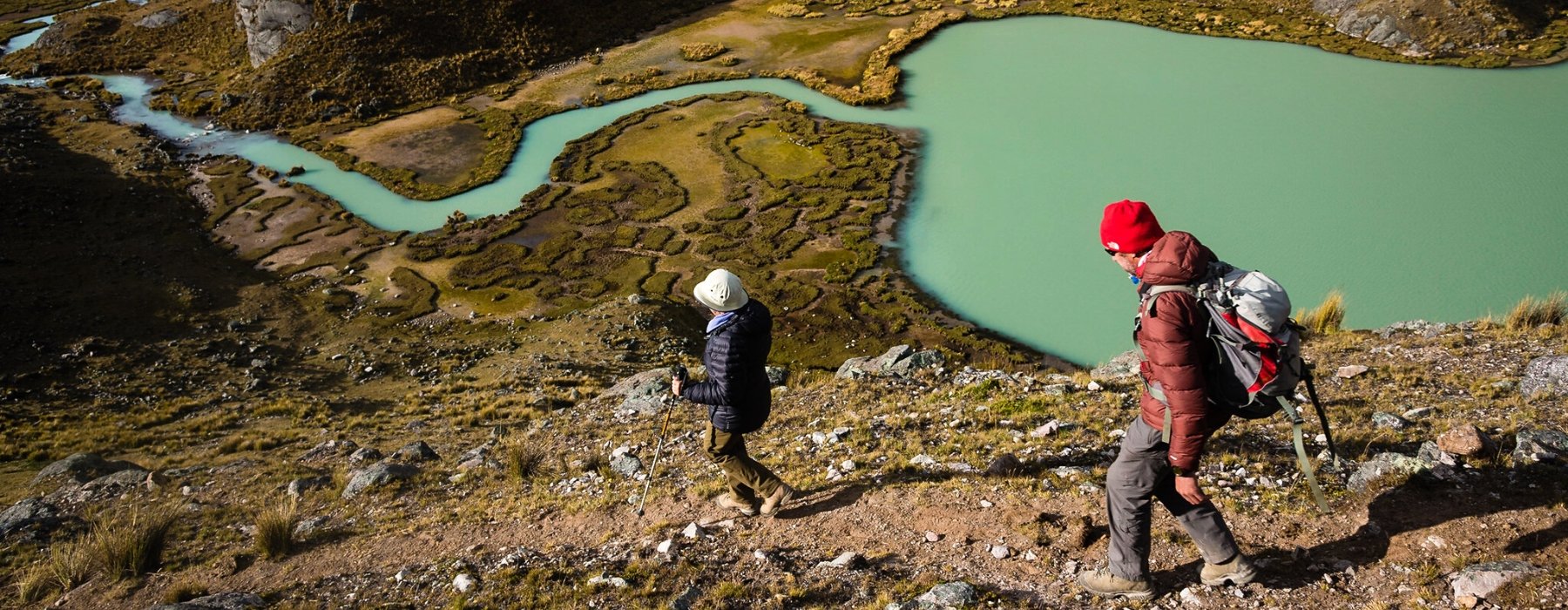
Nothing gets you closer to a country than walking through it, and we’ve got trips to suit walkers of all levels and interests.
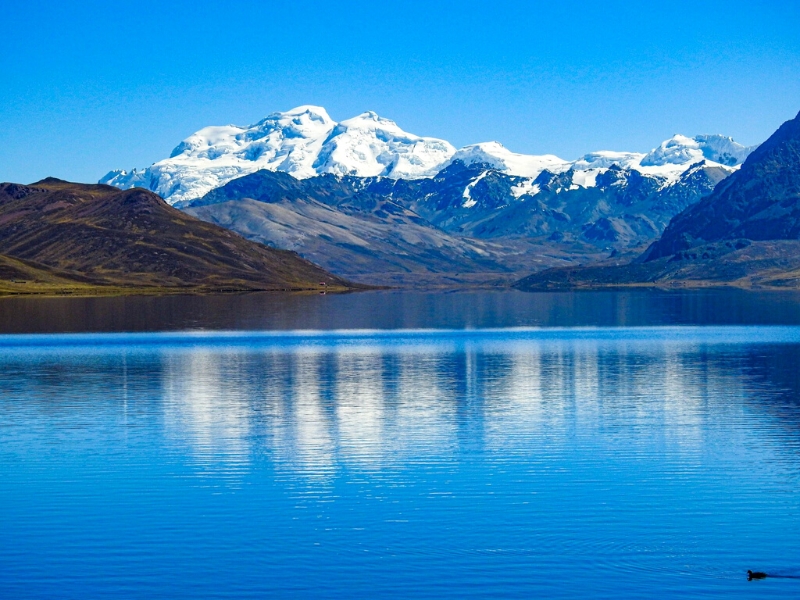
All our Walking trips are graded from ‘Easy’ through to ‘Challenging to Tough’. On our online trip itineraries you’ll find a chart showing the daily walk distances, timings and information on the route including the terrain, altitude. Generally, no specific training is needed but you might feel more comfortable if you’ve got out walking a few times in the lead-up to your trip.
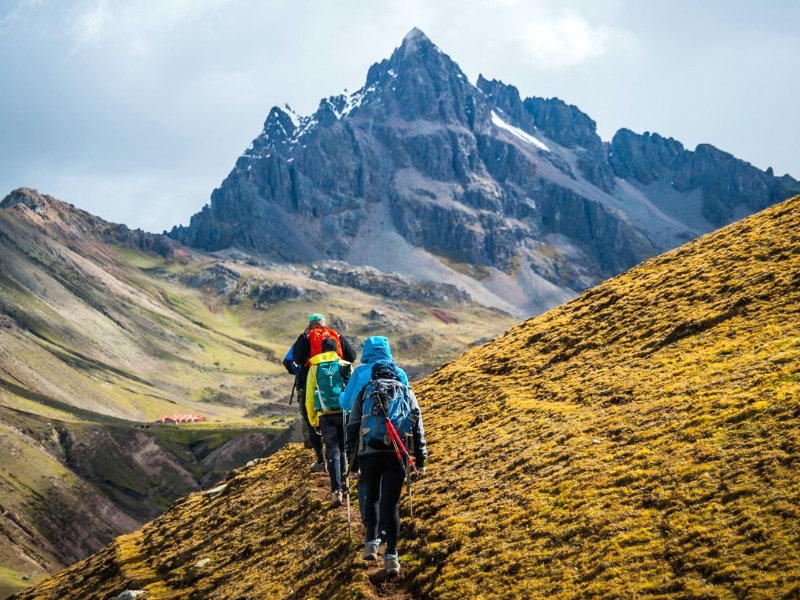
As with all our trips, every group is different but the ‘average’ group consists of roughly half couples and half solo travellers – all sharing a passion for exploring the world on foot. You’ll always have someone to keep you company along the route, but you don’t always have to walk together. Wherever possible your Andean Great Treks leader will allow everyone to walk at their own pace, regrouping regularly along the route.
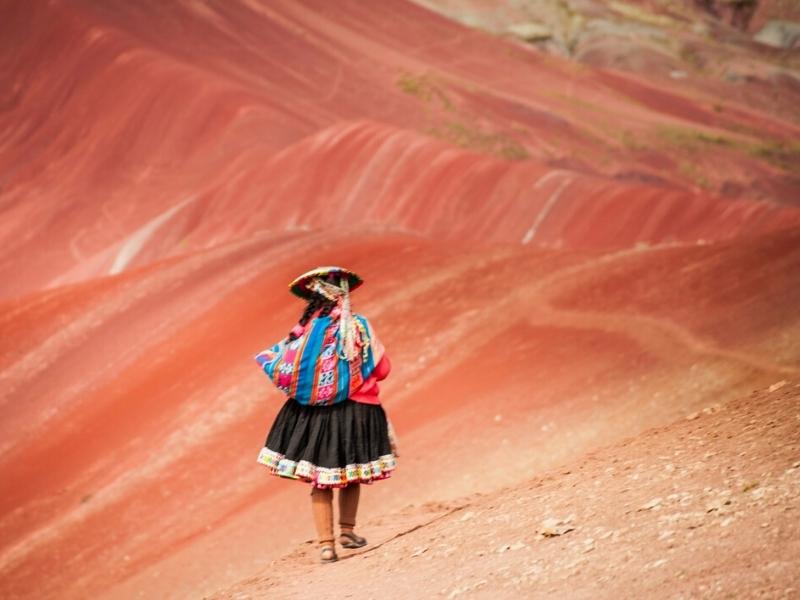
Mostly of our hikes in the mountains in Peru and Cusco like the classic Inca Trail to Machu Picchu, Ausangate Trek, Lares Trek, Ancascocha Trek, Salkantay Trek , involves an average of walking hours of 7-8 hours per day, this timing includes stops for taking photos, lunch, breaks for recovery the energy, and the most important we adapt to your walking pace. This relaxed style of trip involves to know all the attractions in greater depth.
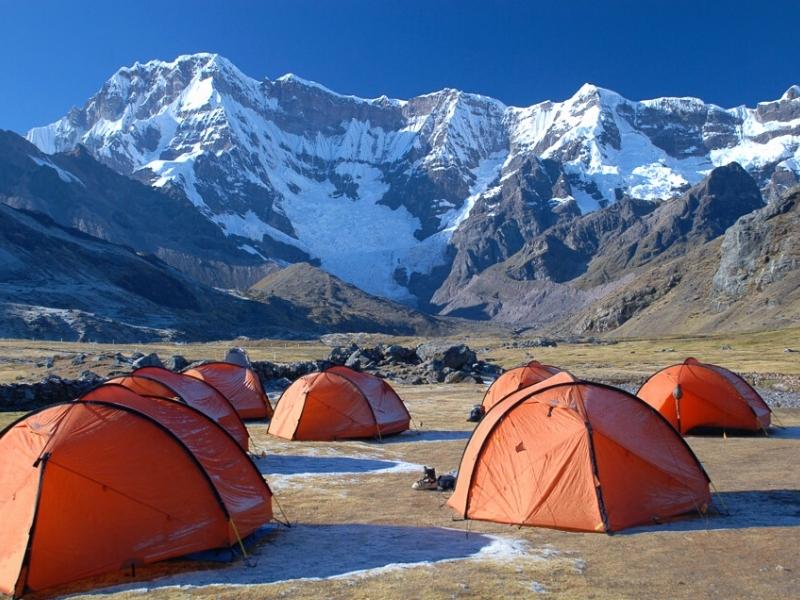
On nearly all our Walking trips, porters or mules will carry all the camping equimpent, so your main luggage will be transported for you. We recommend walk with a light rucksack, you will carry water, snacks, a camera, a small first aid kit and any extra clothing or sun protection. On more remote or challenging treks, additional guides are there to assist the leader tour guide and provide support to the group.
The acclimatization period is very important for our travelers to enjoy the experience. We suggest a minimum of 3 or 4 days of the previous stay in Cusco city, the Sacred Valley of the Incas or Machu Picchu. We recommend you check the acclimation programs we have prepared for you on our website.
The average height of our camps in the trekking circuits is 3,500 masl. In fact, one of the circuits where you sleep at the highest altitude is the Ausangate Trek, where you will have days to set up the tents at a height of 4,300 meters. Remember that Peru has snowy peaks that reach up to 6,700 masl.
From 3,000 meters above sea level, the symptoms of “altitude sickness” vary according to each person, and may even not occur. However, among the most common are a headache, dizziness, nausea, loss of appetite and insomnia. Therefore, upon arriving in the city of Cusco, located at 3,400 meters above sea level, we recommend our travelers to take a good rest, drink plenty of water, eat light meals and take slower walking. Also, it is necessary to avoid alcoholic beverages and cigarettes. The symptoms can be alleviated with high mountain medicines such as DIAMOX or similar products, but we suggest you consult with your doctor before the trip.
While on the trail, hikers will need to carry a daypack (camera equipment, water bottle, extra layers, rain gear, and other accessories you might need on the trail.) Horses and llamas will carry your duffle bag to the next camping site.
The company makes the greatest efforts to provide a safe and unforgettable experience, for this reason, the trekking guides are constantly communicated with the central office through satellite phones, ensuring the welfare of each passenger. Our guides are trained in rescue techniques and first aid in emergency outdoor, these courses are developed annually and have the standards of the wilderness first respond. At all times we have oxygen and first aid equipment. In case of any eventuality a medical director will answer our questions 24 hours a day. In addition to the animals who carry the luggage we have horses to help walkers tired or eager to ride. We recommend getting a travel insurance.
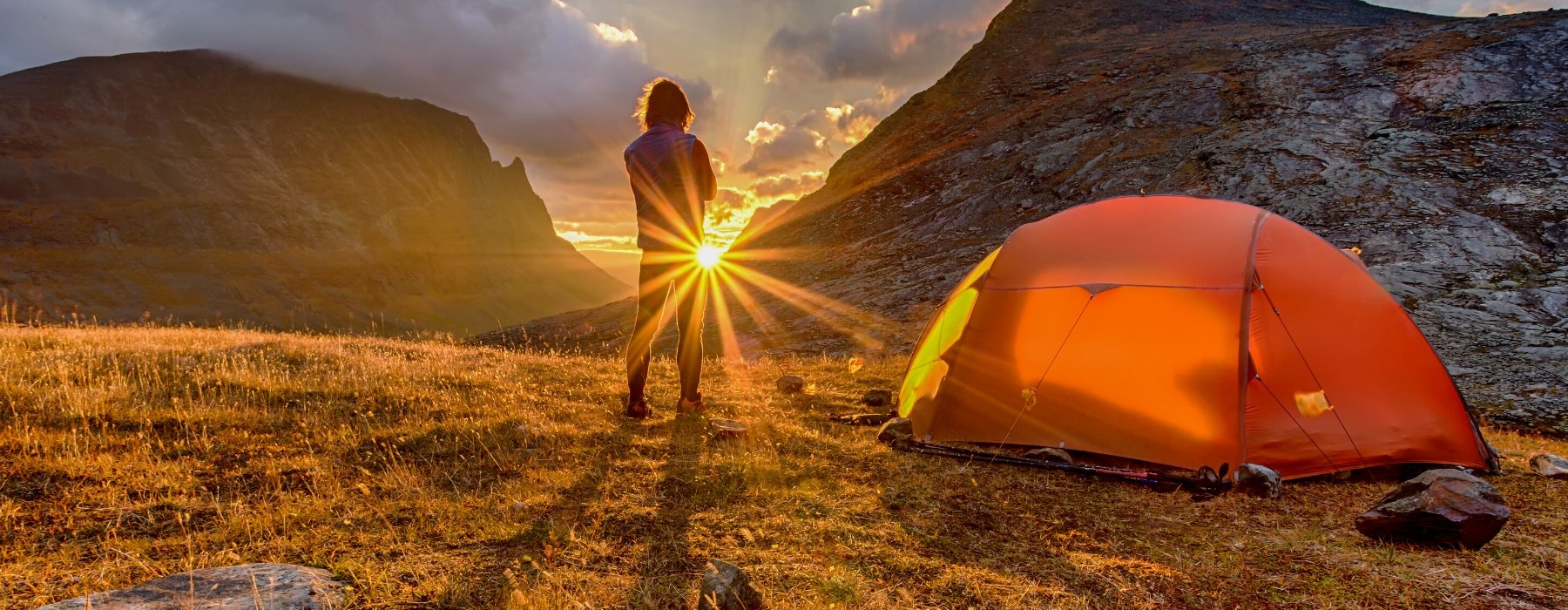
Every Andean Great Treks holiday has been thoughtfully planned and crafted by our specialists. They draw on their own extensive travel experience and the guidance and expertise of our local partners to create superb holidays. Our specialists are committed to making every aspect smooth and enjoyable; they genuinely want to ensure that the holidays they create leave you with wonderful lasting memories.
Every Andean Great Treks traveller is accompanied by an experienced tour guide, you will be immersed in Historic cities, ancient ruins and unfamiliar landscapes are all brought to life by our carefully selected local guides. They want to share their expertise and help you make your own discoveries too; their sole mission is to ensure you enjoy every moment.
Giving you the freedom to make your holiday even more memorable. We know how much our customers look forward to their holiday and we pride ourselves on the choice and flexibility that we offer to enhance every aspect of your experience. Whether it’s getting to the airport, upgrading your room or booking an additional excursion, we can help.
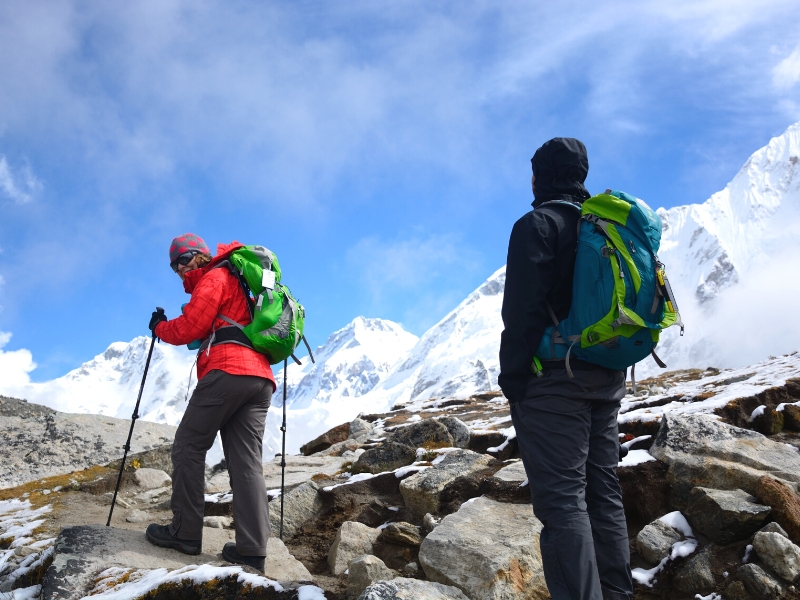
Our guides are the stars of the show; it is their unrivalled knowledge, passion and expertise that will transform your tour experience from good to truly extraordinary!
Because the have grown up in the area and know it like the back of their hand, so they can help you experience whichever aspects most interest you. They’re passionate about sharing their corner of the world with you, and as you explore together, they’ll open your eyes to the intricate details, provide background to enhance your understanding of what you’re seeing, and share stories that will bring everything to life.
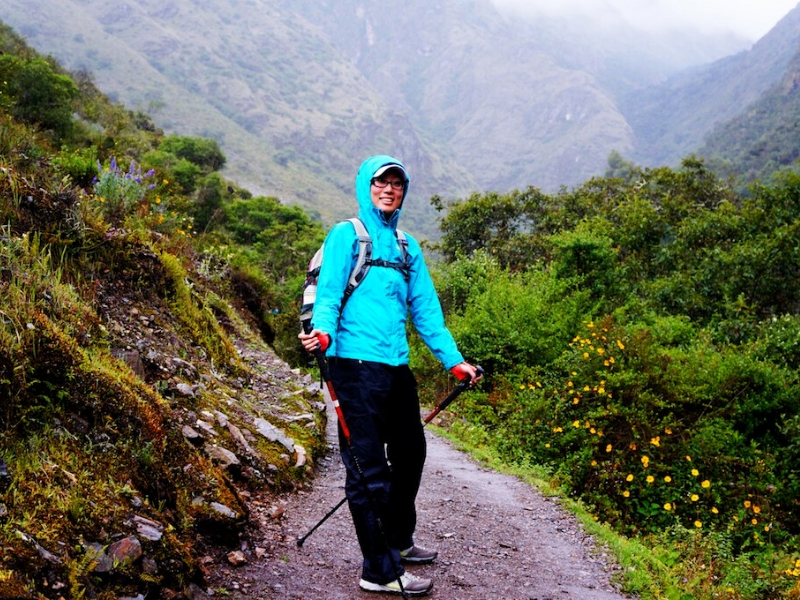
“Your inspiration for a trip can be a single word or a highly evolved outline, but it’s the conversations we have that help us understand the experience you’re looking for. Meanwhile, I’m looking back on the time I spent at the destination.
‘The great thing about working with a specialist at Andean Great Treks is how they take your complete jumble of ideas and turn them into something absolutely spectacular.’
As you begin to share your ideas with your specialist, it will connect them immediately back to a time in their own travels. Conjuring a picture of the rest time they made that same discovery, reminding them how it felt.
Your specialist understands that, when the journey is right, it has the power to excite your emotions in the most profound ways after all, that was the effect on them.
They carry a treasure box of moments, captured over many journeys, into every suggestion they’ll share with you, as they ask you how you want to feel on your trip.
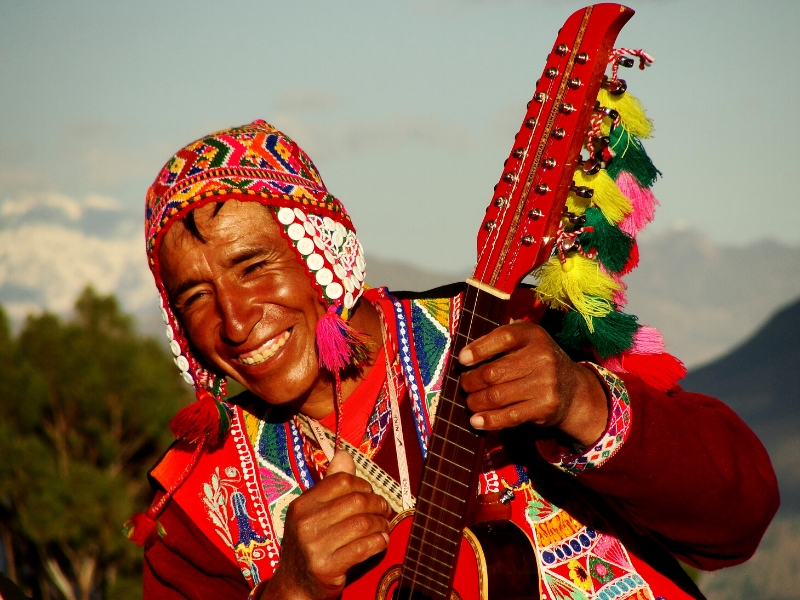
EXPERIENCES THAT CALL TO YOU
It’s what you do in a destination that helps bring it to life. It’s why we strive to choose experiences that help you connect to a place, absorbing a little of its complex character. Wherever your passions lie, we’ll recommend experiences that speak to you, and we’ll recommend the guide or local expert who’s most qualified to help you explore. Packing your holiday full of special experiences means some early starts and long days, but you can be sure that you’ll return home with many incredible memories! Read our Tours and check the Physical Ratings to see if the pace and activity levels are right for you.
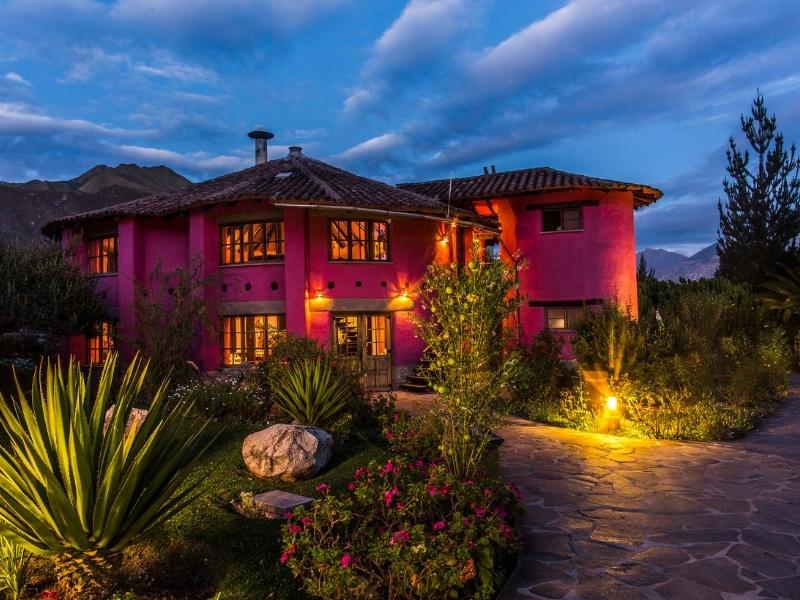
STAYS WITH DIFFERENCE
We know that where you stay is a cherished part of your travels. So, we go to great lengths to find places to stay that exceed expectations, or go above and beyond the ordinary, whether in their character, hospitality, or location. Over the years, we’ve discovered the very best properties, trying and testing them, so we can choose the right one for you. We’ve nourished long-standing relationships with these establishments and the people who founded them, and we’ve stayed there many times often, we’ll even know which rooms have the best views (and reserve them for you).
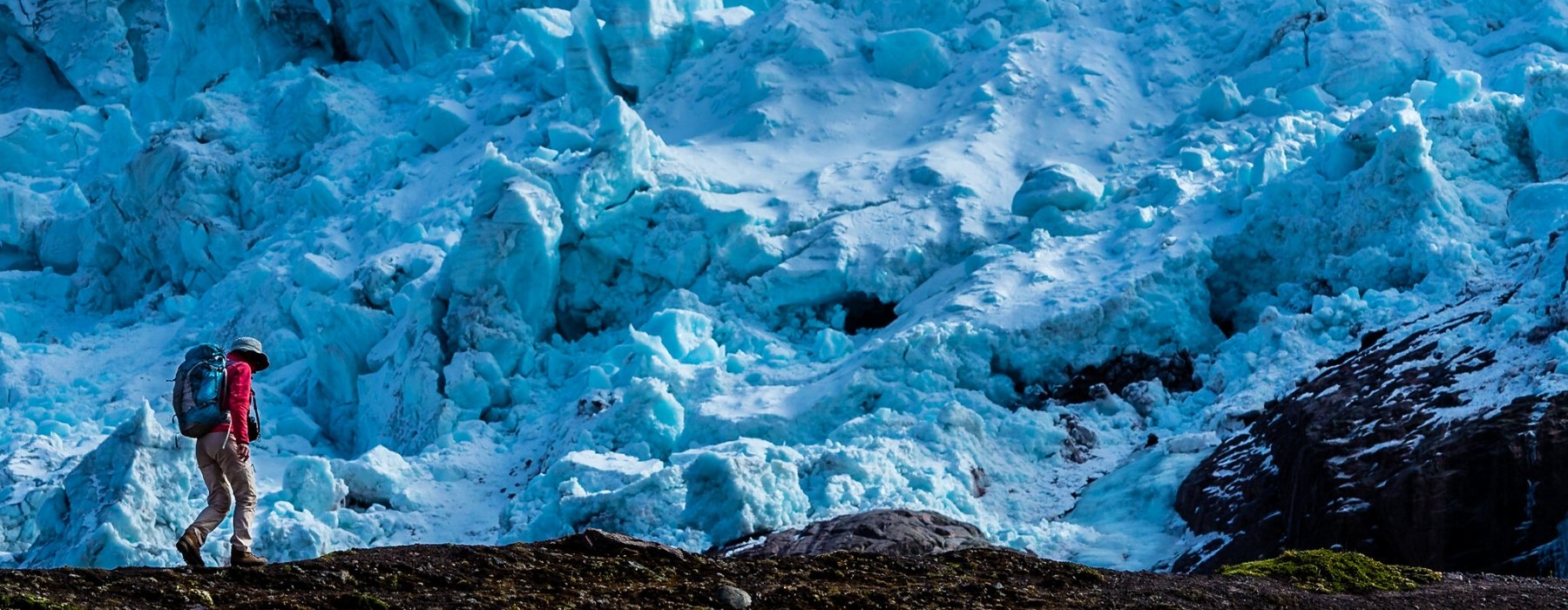
Our style of travel — authentic, thoughtful, and focused on building meaningful connections to the people and places you visit — is inherently respectful and considerate of the destinations we love. We design each aspect of your trip exactly as you want it, which includes its sustainability. That might mean choosing a train journey instead of a flight, staying at eco-friendly wildlife lodges, or opting for experiences that give back to the communities you’re visiting. The choice is yours.
Responsible travel has always been at the heart of what we do. First and foremost, because it gives you the best experience, but, also because it helps to preserve the communities and landscapes you visit. This isn’t new for us we collaborated with local communities and outside experts so we can grow to be better ambassadors.
The most authentic and interesting experiences often directly benefit the local people. We prefer to buy local products that are produced in the organic farms of the Sacred Valley, we also have alliances with local artisan organizations who provide us with souvenir items for our clients, your money directly benefits the local economy.
Our style of travel — authentic, thoughtful, and focused on building meaningful connections to the people and places you visit — is inherently respectful and considerate of the destinations we love. We design each aspect of your trip exactly as you want it, which includes its sustainability. That might mean choosing a train journey instead of a flight, staying at eco-friendly wildlife lodges, or opting for experiences that give back to the communities you’re visiting. The choice is yours.
Responsible travel has always been at the heart of what we do. First and foremost, because it gives you the best experience, but, also because it helps to preserve the communities and landscapes you visit. This isn’t new for us we collaborated with local communities and outside experts so we can grow to be better ambassadors.
The most authentic and interesting experiences often directly benefit the local people. We prefer to buy local products that are produced in the organic farms of the Sacred Valley, we also have alliances with local artisan organizations who provide us with souvenir items for our clients, your money directly benefits the local economy.
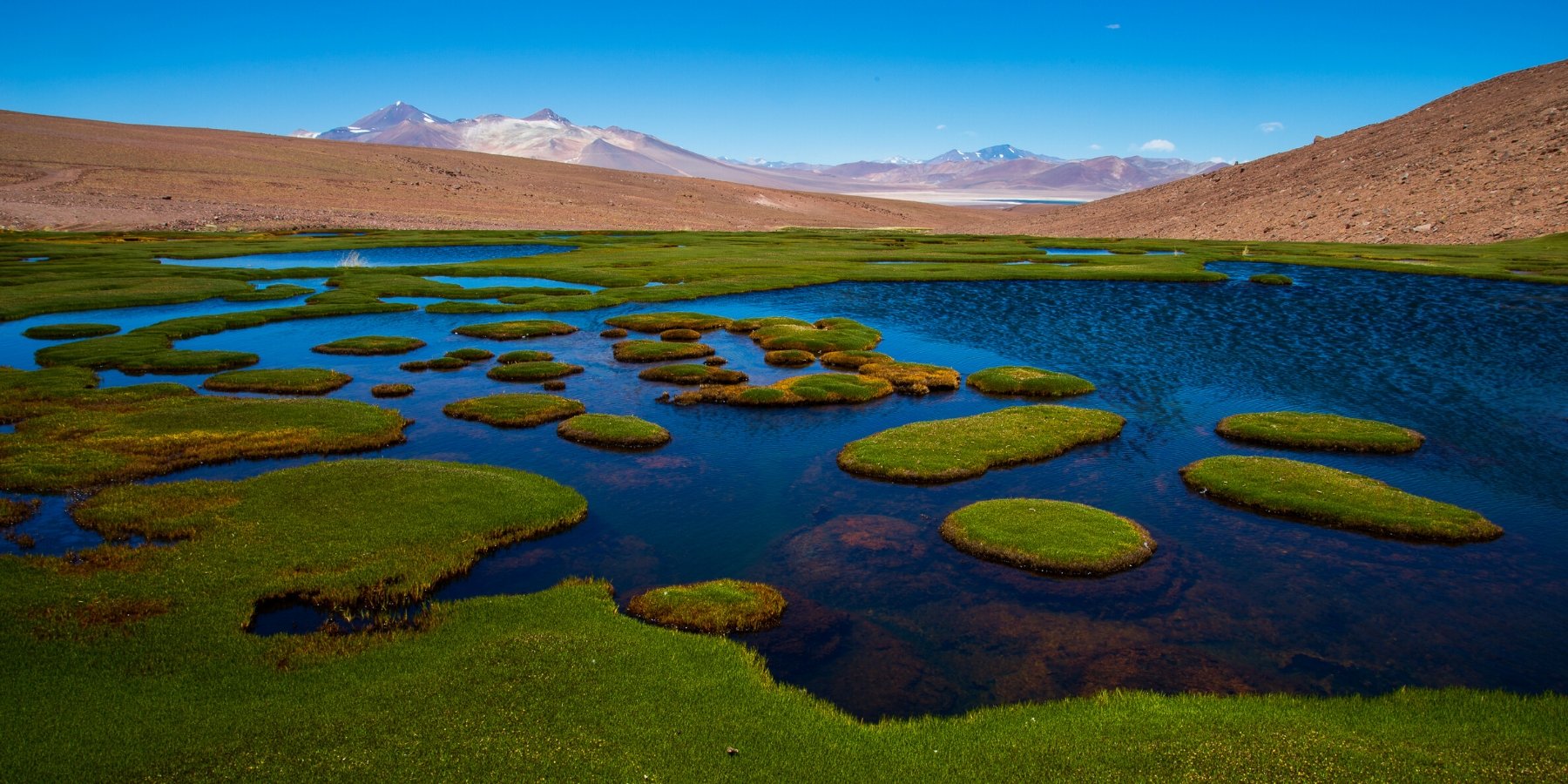
‘There’s a saying: we don’t inherit the Earth from our ancestors, we borrow it from our children. When we show you our country, this philosophy guides everything we do. It’s our responsibility to preserve the environment and wildlife, and support communities. That means using slower modes of transport, like cycling, employing local people, and working with communities who’ll benefit directly from your visit. This also gives you the best, most authentic impression of the places we want to share with you.
We prefer to buy local products in ecological bags, to avoid the use of plastic bags, likewise we teach the use of soaps and ecological products in each tour that we organize. We also work on reforestation projects with local communities who take care of landscape resources such as communal reserves, national parks.
‘There’s a saying: we don’t inherit the Earth from our ancestors, we borrow it from our children. When we show you our country, this philosophy guides everything we do. It’s our responsibility to preserve the environment and wildlife, and support communities. That means using slower modes of transport, like cycling, employing local people, and working with communities who’ll benefit directly from your visit. This also gives you the best, most authentic impression of the places we want to share with you.
We prefer to buy local products in ecological bags, to avoid the use of plastic bags, likewise we teach the use of soaps and ecological products in each tour that we organize. We also work on reforestation projects with local communities who take care of landscape resources such as communal reserves, national parks.
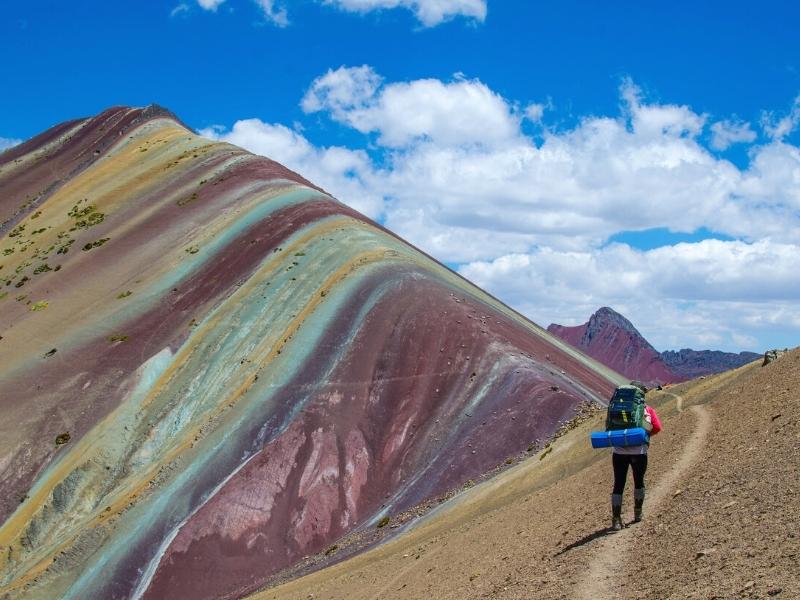
Ausangate Trek & Rainbow Mountain, Explore this route of turquoise lakes, imposing snow-capped mountains, little-visited trails and Very experienced trekking guides.
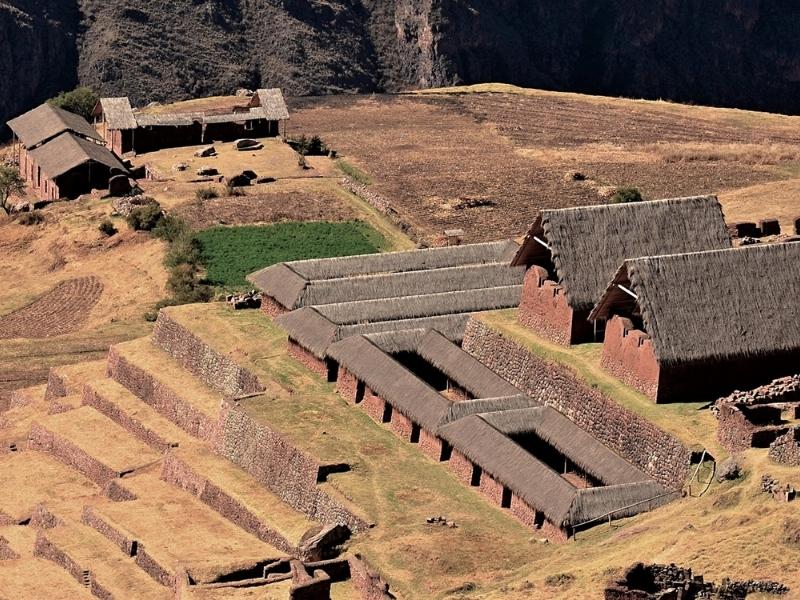
The walk from Huchuy Qosqo to Machu Picchu, is one of the shortest in Cusco, but full of unique landscapes, and towns with ancient traditions. This circuit is recommended for tourists who want to know little-visited places, with a camp from where you can see a unique sunrise of the Sacred Valley of the Incas.
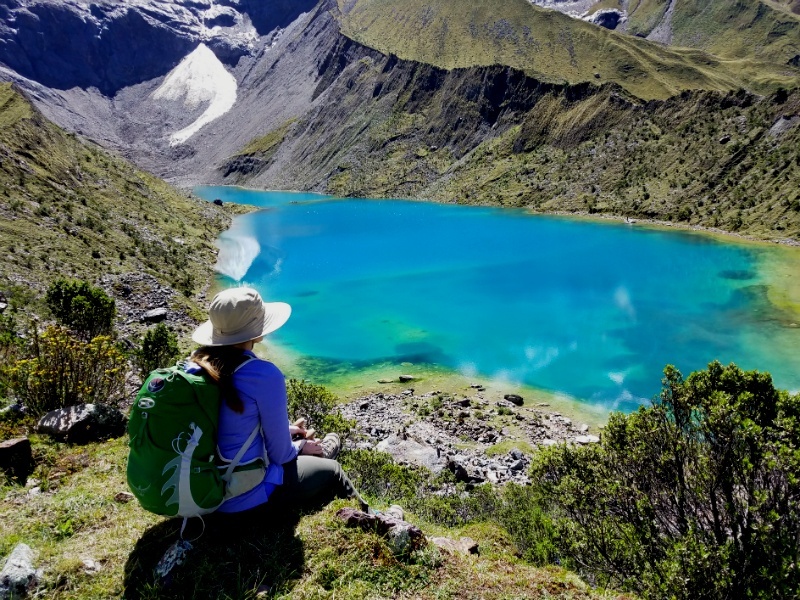
Salkantay Trek is the second best hiking option to Machu Picchu, offering a totally full of natural scenes , passing the majestic Salkantay snow mountain.